
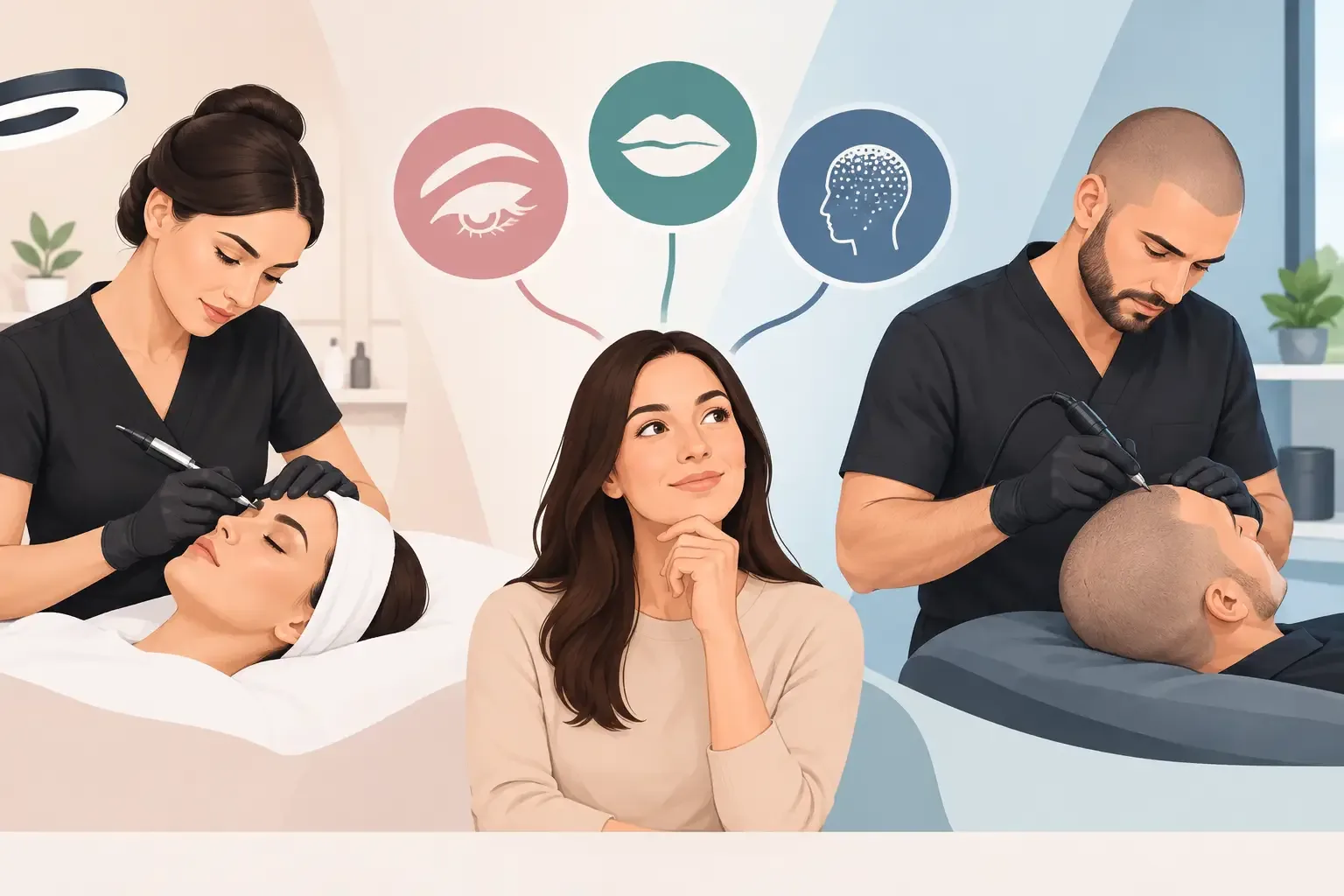
A permanent makeup education should feel as precise as the work you plan to perform. PMU course formats vary widely, and the right choice affects more than your schedule or tuition. It shapes how much hands-on feedback you receive, how confidently you work with skin, pigments, and machines, and how prepared you are to build a trusted beauty career.
For an aspiring artist, a working esthetician, or a beauty professional ready to add nano eyebrows, lip blushing, or scalp micropigmentation to an existing practice, the best format depends on your experience, learning style, and professional goal. A course with a lower price or shorter timeline is not automatically the stronger investment. In permanent makeup, technical correction, safety standards, and supervised practice matter.
The Main PMU Course Formats
Most professional training programs fall into three broad formats: group courses, private training, and hybrid learning. Each can provide value when the curriculum is well structured and the instructor offers meaningful practical guidance.
Group PMU training
Group training places several students in the same class with one or more instructors. This format is often a smart entry point for beginners who want a clear foundation in permanent makeup principles, brow design, color theory, sanitation, contraindications, client consultation, and machine or manual techniques.
A well-run group course gives students the energy of a shared learning environment. You can watch other artists ask questions, observe different hand positions, and learn from common early mistakes before making them yourself. It can also create a professional network that continues after class, especially for artists who are starting their businesses at the same time.
The trade-off is instructor attention. In a larger class, even an experienced educator has limited time to correct every stroke pattern, depth issue, or symmetry concern in the moment. Before enrolling, ask about the maximum class size, the instructor-to-student ratio, and how much live model support is included. A group course should never leave students to practice on a model without close supervision.
Private PMU training
Private training is designed around one student or a very small number of students. It is particularly valuable for artists who want concentrated mentorship, have a specific technique in mind, or need help correcting habits developed in prior training.
With private instruction, the pace can be adjusted to your skill level. A beginner may spend additional time on skin anatomy, latex practice, brow mapping, and needle control before working on a model. An experienced artist may focus almost entirely on refining nano strokes, achieving soft ombre saturation, improving healed retention, or learning a specialized restorative service such as scar camouflage tattooing.
This format is typically a higher financial investment, but it can reduce costly guesswork. In PMU, an instructor seeing your work up close can identify issues that are difficult to correct through general demonstrations alone, including inconsistent depth, excessive pressure, poor stretch, uneven pixel placement, or pigment selection that does not suit the client’s undertone.
Private education works best when you arrive with clear goals. If you are booking a one-on-one course, define what you want to leave with: stronger machine control, a portfolio-ready model procedure, confidence in dark lip neutralization, or a plan for introducing paramedical tattooing into your service menu.
Hybrid PMU education
Hybrid programs combine online lessons with in-person practical training. Theory is commonly delivered before class so students can use on-site time for mapping, practice, demonstrations, and live models rather than spending the entire day in a lecture.
This can be an efficient format for busy professionals. Online modules may cover bloodborne pathogen awareness, client forms, skin structure, pigment basics, healing protocols, photography, business setup, and aftercare. Students can revisit these materials at their own pace, which is useful when preparing for an exam or reviewing a concept before an appointment.
Still, hybrid education should not mean theory only. Watching a video is helpful, but it does not replace an instructor correcting your posture, checking your hand speed, or assessing whether your implantation technique is appropriate for the skin. For foundational PMU training, prioritize programs that include significant in-person practice and supervised work on live models.
Foundation Courses vs. Advanced Workshops
Course format and course level are not the same thing. A group course can be advanced, and private training can be designed for a complete beginner. Understanding the difference helps you avoid enrolling in a class that does not match your current ability.
A foundation course is for students building their first permanent makeup skill set. It should teach the safety and technical principles behind the procedure, not simply provide a script to follow. For example, a quality ombre powder brow course should explain skin types, color theory, machine movement, brow architecture, healing expectations, touch-up planning, consent, and when a client is not an appropriate candidate.
Advanced workshops are best for artists who already understand fundamental sanitation and implantation principles. These courses focus on a specific service or improvement area, such as nano eyebrows, combo brows, lip blushing, dark lip neutralization, scalp micropigmentation, areola restoration, or camouflage tattooing for scars and stretch marks.
Specialized training is not just a way to expand a menu. It allows an artist to serve clients whose concerns require greater sensitivity and clinical awareness. Paramedical tattooing, for example, calls for thoughtful consultation, realistic expectations, careful color matching, and an understanding that healing skin can respond differently than healthy facial skin.
How Much Hands-On Practice Should You Expect?
The strongest PMU course formats place practical training at the center of the experience. Theory creates the framework, but artists develop confidence through repeated observation, guided practice, and detailed correction.
Look for a program that moves through practice intentionally. Students should begin by understanding the procedure and tools, then practice mapping and technical movements on suitable materials, observe a full demonstration, and perform supervised work on a live model when ready. The instructor should explain not only what they are doing, but why they chose a pigment, needle configuration, design adjustment, or saturation technique.
Live model experience is especially valuable because real skin presents variables that practice skins cannot. Texture, oiliness, mature skin, previous tattoo work, undertones, sensitivity, and client comfort all influence the approach. A course that promises instant expertise after one procedure is not being realistic. Competency grows through continued practice, healed-result review, and honest refinement.
Questions to Ask Before You Enroll
A polished course brochure can make every program sound similar. The details reveal whether the training will support your long-term work. Ask who teaches the course and whether that educator actively performs the techniques being taught. Ask how many students are in each session, whether you will work on a live model, and what support is available after graduation.
You should also understand what is included in tuition. A kit may be helpful, but it should not distract from the depth of education. Clarify whether the course includes pigments, needles, machines, practice materials, manuals, model coordination, certification, business guidance, and post-course mentorship. If financing is available, compare the full course value rather than choosing based only on the monthly payment.
Finally, verify your local and state requirements before offering services. Licensing, bloodborne pathogen education, health department rules, and facility requirements can vary. A reputable academy teaches professional responsibility, but each artist is responsible for understanding the regulations that apply to their practice location.